
Anterior cruciate ligament reconstruction surgery is done to replace a torn anterior cruciate ligament with a graft. The ligament helps keep the knee stable by preventing the shin bone from sliding too far forward. When it tears, the knee can feel unstable and may develop cartilage damage or early arthritis if not treated. Many patients choose reconstruction to restore knee stability and return to activity.
How Common It Is and Who Gets It? (Epidemiology)
Anterior cruciate ligament injuries happen frequently, especially in athletes who play sports involving sudden stops, jumping, and quick changes in direction. Younger, active patients experience these injuries more often, but they can occur in any age group.
Why It Happens – Causes (Etiology and Pathophysiology)
Anterior cruciate ligament tears often occur during sudden twisting motions, direct blows to the knee, awkward landings, or sharp direction changes. These movements can overstretch or rupture the ligament, leading to pain, swelling, and instability. Abnormal movement after injury can speed up knee cartilage wear.
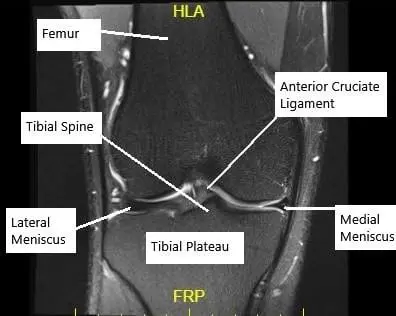
MRI of the knee in the coronal section showing an intact ACL.
Understanding the ACL and its Importance
The ACL is one of the major ligaments in the knee joint, crucial for stability during activities like running, jumping, and pivoting. It connects the thigh bone (femur) to the shin bone (tibia) and prevents excessive forward movement of the tibia in relation to the femur. Without a functioning ACL, the knee can feel unstable, making it difficult to perform everyday tasks and sports activities.
Causes of ACL Injuries: ACL injuries often occur during sports that involve sudden stops, changes in direction, or jumping. Common causes include sudden twisting motions, direct blows to the knee, or landing awkwardly from a jump. These movements can stretch or tear the ACL, leading to pain, swelling, and instability in the knee.
Why ACL Reconstruction Surgery? Not all ACL injuries require surgery, but for individuals who want to return to sports or activities that involve strenuous knee movements, reconstruction surgery may be necessary. The goal of surgery is to replace the torn ACL with a graft, typically from another part of the body or a donor. This graft serves as a scaffold for new tissue growth, eventually becoming a new ACL.
Preparation for ACL Reconstruction Surgery: Before surgery, you’ll undergo a thorough evaluation, including imaging tests like MRI scans, to assess the extent of the ACL injury. Your surgeon will discuss the procedure with you, including the type of graft to be used and any potential risks or complications. It’s essential to follow preoperative instructions, such as fasting before surgery and avoiding certain medications that can increase bleeding risk.
How the Body Part Normally Works? (Relevant Anatomy)
The anterior cruciate ligament connects the thigh bone to the shin bone. Its main role is preventing the shin bone from moving too far forward and controlling rotation during running, pivoting, or jumping. Without the anterior cruciate ligament, the knee can feel loose and unstable.
What You Might Feel – Symptoms (Clinical Presentation)
A tear may cause sudden pain, swelling, and difficulty walking. Many people feel the knee give way or become unstable. Instability may continue with daily activities or sports.
How Doctors Find the Problem? (Diagnosis and Imaging)
Imaging such as an MRI is used to confirm an anterior cruciate ligament tear and evaluate the surrounding structures. The MRI shows the condition of the ligament and helps guide treatment planning.
Classification
Anterior cruciate ligament injuries may be complete tears or partial tears. They vary in severity based on the amount of instability and associated injuries such as meniscus tears.
Other Problems That Can Feel Similar (Differential Diagnosis)
Other injuries that may resemble anterior cruciate ligament tears include meniscus tears, collateral ligament injuries, cartilage injuries, or bone bruises.
Treatment Options
Non-Surgical Care
Some patients may be treated without surgery using a brace. This is more common for older patients or those who already have arthritic changes in the knee. The ligament may scar down and provide partial function, but the outcome is unpredictable.
Surgical Care
Reconstruction surgery replaces the torn anterior cruciate ligament with a graft. Graft choices include hamstring tendon, quadriceps tendon, patella tendon, or donor tendon. A camera is placed inside the knee to inspect the joint surfaces and treat any associated injuries. Bone tunnels are created so the graft can be passed and secured in place to function as the new ligament.
ACL reconstruction is a unique surgery in that its success is not only determined by a successful surgical procedure, but a careful and diligent rehabilitation protocol thereafter. Return to sporting activity will depend on the individual patient and their chosen sport, but generally speaking the more intense the sport, the longer it will be before safe return to play – for example golfers may return within a few months, soccer players usually take 6 months or longer. However, the vast majority of patients who undergo reconstruction will be able to return to sporting activity eventually.
Recovery and What to Expect After Treatment
Recovery from anterior cruciate ligament reconstruction is gradual. Pain medication helps with early discomfort, and crutches may be needed after surgery. Physical therapy plays a major role in regaining motion, strength, and stability. Return to activity happens slowly over months depending on healing and graft type.
Possible Risks or Side Effects (Complications)
Risks include infection, bleeding, blood clots, graft failure, or re-tearing. Following rehabilitation closely is important because not completing the rehabilitation program increases the risk of problems.
Long-Term Outlook (Prognosis)
The success of reconstruction depends on both the surgery and the rehabilitation that follows. Most patients eventually return to sports or full activity. More intense sports usually require a longer recovery time.
Out-of-Pocket Costs
Medicare
CPT Code 29888 – ACL Reconstruction Surgery: $229.85
Medicare usually pays most of the allowed amount for this procedure, and the patient is left with the standard twenty percent portion. Supplemental plans such as Medigap, AARP, or Blue Cross Blue Shield typically remove that remaining share, so many patients end up with no additional expense when the surgery is Medicare-approved. These supplemental plans work together with Medicare and are meant to close the financial gap left by co-insurance.
Secondary insurance, including employer-based plans, TRICARE, or the Veterans Health Administration, steps in after Medicare. These policies may take care of the leftover balance once any deductible is met. Deductibles in secondary plans often fall between one hundred and three hundred dollars, and after that amount is satisfied, they may cover the rest of the charges related to the reconstruction.
Workers’ Compensation
If your ACL injury happened because of a work-related accident, Workers’ Compensation covers the full cost of the surgery and all related medical care. This leaves you with no out-of-pocket responsibility.
No-Fault Insurance
If the ACL injury resulted from a motor vehicle accident, No-Fault Insurance pays for the entire procedure. The only possible cost to you would be a small deductible depending on your specific policy.
Example
A patient required ACL reconstruction after a sudden twisting injury. With Medicare, the expected out-of-pocket cost was 229.85 dollars. Because the patient also carried secondary insurance, that remaining balance was paid in full, leaving the patient with no out-of-pocket expense.
Frequently Asked Questions (FAQ)
Q. Do all anterior cruciate ligament tears require surgery?
A. No. Some individuals may be treated with a brace, but many choose surgery for knee stability.
Q. What type of graft is best?
A. Each graft option has advantages and disadvantages. The surgeon helps choose based on the individual case.
Q. How long until I can return to sports?
A. It varies. Golfers may return in a few months, while soccer players usually take six months or longer.
Q. Can older adults have reconstruction?
A. Older adults with arthritis may be advised to use a brace until they need a knee replacement.
Q. Is rehabilitation important?
A. Yes. A careful rehabilitation program is essential for a good outcome.
Summary and Takeaway
Anterior cruciate ligament reconstruction is a successful surgery used to restore stability to the knee and protect it from early arthritis. It is common in athletes but also helps non-athletes who injure the ligament. Patients should meet with an orthopedic surgeon to review their options and determine whether reconstruction is right for them.
Clinical Insight and Recent Findings
A recent study reviewing early rehabilitation after anterior cruciate ligament reconstruction found that adding open-kinetic-chain strengthening—when started at least four weeks after surgery and combined with closed-kinetic-chain work—improves quadriceps strength, patient-reported knee function, and return-to-sport timelines without increasing graft laxity or complication risk.
These findings support the principles described in your overview of anterior cruciate ligament reconstruction: although surgical success depends on restoring stability with a well-positioned graft, long-term outcomes hinge on carefully structured rehabilitation that gradually loads the healing ligament while rebuilding strength needed for running, pivoting, and returning to sport.
Because early uncontrolled stress can compromise the graft while delayed strengthening can slow recovery, the study reinforces why surgeons emphasize a phased program, beginning with protection and swelling control, followed by progressive strengthening, gait retraining, and sport-specific restoration.
This evidence helps explain why most patients—particularly younger, active individuals—can expect to resume demanding activities with proper postoperative guidance and why adherence to rehabilitation is as important as the reconstruction itself. (“Study of early rehabilitation after anterior cruciate ligament reconstruction – See PubMed.“)
Who Performs This Treatment? (Specialists and Team Involved)
Orthopedic surgeons perform anterior cruciate ligament reconstruction. The team also includes anesthesiologists, nurses, and physical therapists involved in recovery.
When to See a Specialist?
A specialist should be seen when the knee feels unstable, gives way, or continues to swell after injury.
When to Go to the Emergency Room?
Emergency care is needed if there is sudden severe swelling, uncontrolled pain, or symptoms suggesting a blood clot or infection.
What Recovery Really Looks Like?
Recovery involves pain control, gradual improvements in motion, strengthening exercises, and a structured physical therapy program. Returning to full activity takes months and varies by sport and healing.
What Happens If You Ignore It?
Ignoring an anterior cruciate ligament tear may lead to ongoing instability, cartilage damage, and early arthritis.
How to Prevent It?
Avoid sudden twisting movements, strengthen leg muscles, and practice proper technique during sports to reduce the risk of injury.
Nutrition and Bone or Joint Health
Healthy eating supports healing. Balanced meals help with strength and tissue recovery after surgery.
Activity and Lifestyle Modifications
Activity increases in stages. Light activities begin early, while more strenuous activities take months. Guidance from the surgeon and physical therapist helps prevent reinjury.
Do you have more questions?
How long does ACL reconstruction surgery typically take?
ACL reconstruction surgery usually takes around 1 to 2 hours, depending on the complexity of the injury and the technique used.
Will I need to stay overnight in the hospital after ACL reconstruction surgery?
In most cases, ACL reconstruction surgery is performed on an outpatient basis, meaning you can go home the same day. However, some individuals may require overnight observation, particularly if there are concerns about pain management or other medical issues.
When can I expect to return to sports or physical activities after ACL reconstruction surgery?
The timeline for returning to sports or physical activities varies depending on factors such as the type of graft used, the extent of the injury, and your progress in rehabilitation. In general, most individuals can expect to return to sports within 6 to 12 months after surgery.
Will I be able to fully bend and straighten my knee after ACL reconstruction surgery?
Yes, restoring full range of motion in the knee is an essential goal of ACL reconstruction surgery. Physical therapy will focus on gradually increasing flexibility and strength in the knee joint.
Are there any long-term complications associated with ACL reconstruction surgery?
While ACL reconstruction surgery is generally safe and effective, there is a risk of long-term complications such as arthritis and decreased range of motion in the knee. However, these risks can be minimized by following rehabilitation protocols and maintaining a healthy lifestyle.
Can ACL reconstruction surgery be performed on older individuals?
Yes, ACL reconstruction surgery can be performed on individuals of all ages, including older adults. However, the decision to undergo surgery should be based on factors such as overall health, activity level, and goals for recovery.
What can I do to prevent re-injury after ACL reconstruction surgery?
To prevent re-injury after ACL reconstruction surgery, it’s essential to follow your surgeon and physical therapist’s recommendations for rehabilitation and gradually return to activities. This may include wearing a knee brace during sports and practicing proper technique to avoid sudden movements that could stress the knee.
Will I need to wear a knee brace after ACL reconstruction surgery?
Whether or not you need to wear a knee brace after ACL reconstruction surgery depends on factors such as the type of graft used, the extent of the injury, and your surgeon’s recommendations. In some cases, a knee brace may be recommended during sports or strenuous activities to provide additional support and stability.
Can ACL reconstruction surgery be performed if I have other knee injuries or conditions?
ACL reconstruction surgery can often be performed in conjunction with treatment for other knee injuries or conditions, such as meniscus tears or cartilage damage. Your surgeon will evaluate your knee thoroughly and develop a treatment plan tailored to your specific needs.
Will I be able to drive after ACL reconstruction surgery?
You may be able to drive after ACL reconstruction surgery once you are no longer taking pain medications that impair your ability to drive safely and your knee is stable enough to operate the pedals without discomfort. It’s important to follow your surgeon’s guidance regarding driving restrictions.
How can I manage pain and discomfort after ACL reconstruction surgery?
Pain and discomfort after ACL reconstruction surgery can be managed with medications prescribed by your surgeon, such as nonsteroidal anti-inflammatory drugs (NSAIDs) or opioids. Additionally, applying ice to the knee and elevating it can help reduce swelling and discomfort.
Will I need to wear a brace or use crutches after ACL reconstruction surgery?
The use of a brace or crutches after ACL reconstruction surgery depends on factors such as the type of graft used and your surgeon’s recommendations. Some individuals may require temporary bracing or assistance with crutches to support the knee during the initial stages of recovery.
What can I do to speed up my recovery after ACL reconstruction surgery?
To optimize recovery after ACL reconstruction surgery, it’s important to follow your surgeon and physical therapist’s recommendations for rehabilitation, including completing prescribed exercises, attending therapy sessions regularly, and avoiding activities that could stress the knee.
Are there any dietary or nutritional recommendations following ACL reconstruction surgery?
While there are no specific dietary or nutritional requirements following ACL reconstruction surgery, maintaining a balanced diet rich in vitamins, minerals, and protein can support healing and recovery. It’s important to stay hydrated and avoid excessive weight gain, which can put added stress on the knee joint.
Can I return to work or school after ACL reconstruction surgery?
The ability to return to work or school after ACL reconstruction surgery depends on factors such as the type of work or school activities involved and your surgeon’s recommendations. In general, individuals can expect to resume light activities within a few days to a week after surgery, gradually increasing activity as tolerated.
Will I need to undergo physical therapy before ACL reconstruction surgery?
Preoperative physical therapy may be recommended in some cases to improve knee strength, range of motion, and overall function before ACL reconstruction surgery. Your surgeon will determine if prehabilitation is necessary based on your individual circumstances.
How can I prevent ACL injuries in the future?
While it’s not always possible to prevent ACL injuries entirely, there are steps you can take to reduce your risk, such as maintaining strong muscles around the knee joint through regular exercise, using proper technique during sports and activities, and wearing appropriate protective gear such as knee braces.
Can ACL reconstruction surgery be performed if I have other medical conditions?
ACL reconstruction surgery can often be performed safely in individuals with other medical conditions, but it’s important to inform your surgeon about any preexisting health conditions or medications you’re taking. Your surgeon will assess the risks and benefits of surgery based on your overall health status.
Will I need to undergo rehabilitation after ACL reconstruction surgery?
Yes, rehabilitation is a crucial component of recovery after ACL reconstruction surgery. Physical therapy will focus on restoring strength, flexibility, and stability in the knee joint, helping you regain function and return to your desired level of activity.
How long does it take to fully recover from ACL reconstruction surgery?
The timeline for full recovery from ACL reconstruction surgery varies from person to person but typically ranges from 6 to 12 months. Factors such as the type of graft used, the extent of the injury, and individual healing abilities can influence the recovery process.
What should I do if I experience persistent pain or swelling after ACL reconstruction surgery?
If you experience persistent pain or swelling after ACL reconstruction surgery, it’s important to contact your surgeon for further evaluation. These symptoms could indicate complications such as infection or graft failure, which may require additional treatment
What are the potential risks and benefits of delaying ACL reconstruction surgery, and when is early intervention recommended?
Delaying ACL reconstruction surgery may increase the risk of further knee damage and instability, but early intervention may not be necessary in all cases, particularly if the patient does not have functional limitations or is not engaged in high-demand activities.
How does the cost of ACL reconstruction surgery vary, and what factors contribute to the overall cost?
The cost of ACL reconstruction surgery may vary depending on factors such as the type of graft used, surgical technique, hospital fees, anesthesia charges, rehabilitation costs, and insurance coverage. Patients should consult with their healthcare provider and insurance company to understand the potential costs involved.