
Knee discomfort is a frequent issue for many people, but if it worsens and starts interfering with your daily life, or if it’s accompanied by swelling, sensitivity, or inflammation, it’s crucial to seek medical help.
Located in New York City and Long Island, we have access to six hospitals and state-of-the-art facilities for advanced knee surgeries and orthopedic care. Booking a consultation with an orthopedic surgeon is easy either online or by phone.
Learn about the different causes and treatments for knee pain, and recognize when surgery is the best option.
Overview
Knee replacement surgery is a common procedure for individuals suffering from severe knee pain and limited mobility due to conditions like osteoarthritis or injury. While the surgery can significantly improve quality of life, proper rehabilitation is crucial for maximizing its benefits and ensuring a successful recovery. One essential aspect of rehabilitation is performing knee replacement exercises tailored to strengthen the muscles around the knee, improve flexibility, and enhance overall function.
In this comprehensive guide, we will delve into the importance of knee replacement exercises, their benefits, and specific exercises you can incorporate into your rehabilitation routine. We’ll also discuss the scientific research supporting the effectiveness of these exercises in promoting recovery and long-term joint health.
Understanding Knee Replacement Surgery
Before delving into exercises, let’s briefly understand knee replacement surgery. During knee replacement, damaged or diseased parts of the knee joint are replaced with artificial components made of metal and plastic. This procedure aims to relieve pain, restore function, and improve mobility for individuals with severe knee conditions.
However, the success of knee replacement surgery relies not only on the surgical procedure itself but also on the post-operative rehabilitation process. Rehabilitation typically begins soon after surgery and involves various interventions, including exercises, physical therapy, and lifestyle modifications.
Importance of Knee Replacement Exercises:
Knee replacement exercises play a pivotal role in the recovery process by addressing several key objectives:
Strengthening Muscles: Strengthening the muscles around the knee joint is essential for providing stability and support. Weak muscles can contribute to instability and increase the risk of injury or complications.
Improving Flexibility: Maintaining or improving flexibility in the knee joint and surrounding muscles is crucial for restoring range of motion and preventing stiffness.
Enhancing Function: Through targeted exercises, individuals can improve their ability to perform daily activities such as walking, climbing stairs, and bending the knee.
Minimizing Pain: Certain exercises can help alleviate pain by reducing inflammation, improving circulation, and promoting the release of endorphins, the body’s natural pain-relieving hormones.
Preventing Complications: Regular exercise can reduce the risk of complications such as muscle atrophy, joint stiffness, and blood clots, which are common after knee replacement surgery.
Exercise and physical therapy after total knee replacement is associated with early return to activity and decrease in post operative pain and stiffness. Knee replacement surgery is a common surgery and the most successful surgery in medicine.
Knee replacement implants on an average last more than 20 years and more. Exercise and physical therapy forms an important part of post operative rehabilitation.
During the surgery, the arthritic ends of the knee joint are replaced with prosthetic metal alloy and plastic parts. The surgery involves cutting of the tissues and the bone to fix the prosthetic parts. A bone cement is used to fix the prosthetic parts at the ends of the thigh bone, shin bone and the undersurface of the patella.
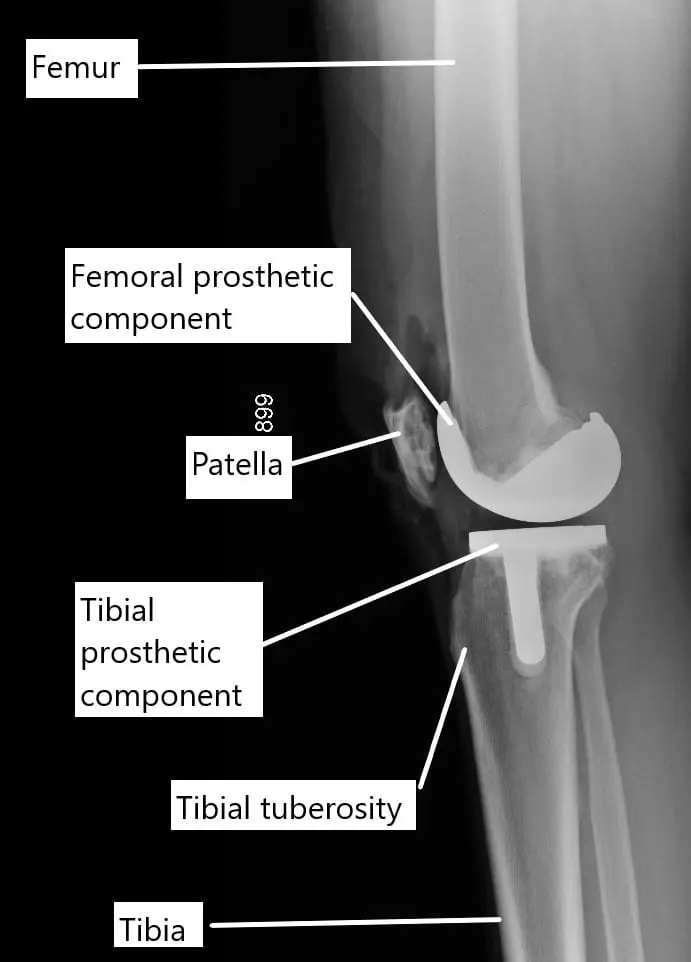
X-ray showing a total knee replacement.
As the muscles and tissues are separated and cut to perform the surgery, a range of motion exercises started after surgery help prevent stiffness. Regular exercise is recommended for at least 30 minutes, repeated 3-4 times a day along with regular walking.
Immediately following the surgery, the patients are advised to do ankle pumps. Ankle pumps involve pushing the ankle down and up while lying straight on the bed. The calf muscles contract when performing ankle pumps. The contraction of calf muscles not only improves circulation but also prevents serious complications like deep vein thrombosis.
Deep vein thrombosis is the formation of blood clots in the veins of the leg that may travel up to the lungs to cause pulmonary embolism. Deep vein thrombosis may occur in response to a major surgery like knee replacement. Exercise and early ambulation helps to improve the circulation that plays a role in preventing deep vein thrombosis.
While lying straight on the bed, the patients are advised to contract their thigh muscles, the thigh muscles (quadriceps) contract helps to straighten the knee. To aid in exercise, the patients are advised to try to touch the back of their knees to the bed and hold it in the position for some time. The exercise is repeated alternatively on each leg and done multiple times a day.
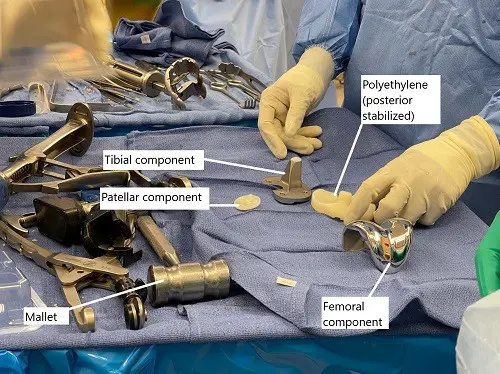
Intraoperative image showing prosthetic component.
Straight leg raise exercise may be performed while lying straight or in sitting position. While lying straight, the patients are advised to try to move their leg straight up in the air, lifting a couple of inches off the bed. The straight leg is held up in the position till the thigh muscles are fatigued. The exercise is repeated on the other leg and multiple repetitions are done throughout the day.
Straight leg raise when performed in a sitting position, involves raising the leg to straighten the knee and holding it in position. Similar to lying down technique, the exercise is repeated multiple times.
Knee bending exercises may be done while lying on the bed or in a sitting position. While lying down on the bed, the patient is advised to slowly bend their knee with their sole of the foot touching the bed. The patients are advised to bend their knee as far as possible and hold in that position for some time and slowly bring it back. The exercise is repeated with an attempt to bend further each time.
The knee bends may be performed using a rubber band for support. The knee band may similarly be performed unsupported or supported while sitting in a chair. In supported knee bends the other leg is used to aid in bending the knee.
Majority of the patients may be able to walk the same day of the surgery or the day after. The patients are advised to walk using a walker as an ambulatory aid. The patients are advised to first be comfortable standing. Once comfortable, the patients are advised to advance their walker forward and move with their operative leg first.
The patients are advised to keep the operated leg straight and move forward with their heel touching the ground first. The amount of weight bearing will depend upon the type of knee replacement.
Once the patients are comfortable walking and standing for long, the patients may be allowed to use a cane for ambulation. Climbing and descending stairs are an important part of daily activity. The patients are advised to climb the stairs one step at a time.
During climbing the stairs, the non operated knee is placed first, while during descending the stairs, the operated knee is placed first. The use of handrail is recommended at all times during navigating the stairs.
Advanced exercises such as resisted knee bends and straightening exercises are initiated under supervision of a physical therapist. The advanced exercises help in building the muscles around the knee and increasing the range of motion.
Exercise and physical therapy after knee replacement not only helps in the early return to activities but also decreases the pain and swelling associated with the surgery. The improvement in circulation with the exercises help in decreasing the swelling. Stiffness of the knee is a common complication when adequate exercise regime is not followed after surgery.
Specific Knee Replacement e Exercises:
Now that we understand the importance and benefits of knee replacement exercises, let’s explore some specific exercises you can incorporate into your rehabilitation routine:
- Quadriceps Sets:
- Sit or lie down with your legs extended.
- Tighten the muscles at the front of your thigh (quadriceps) by pressing the back of your knee down onto the bed or floor.
- Hold for 5-10 seconds, then relax.
- Repeat 10-15 times for 2-3 sets.
- Straight Leg Raises:
- Lie on your back with one leg bent and the other straight.
- Tighten the muscles of the straight leg and lift it off the ground to the level of the bent knee.
- Hold for 5 seconds, then slowly lower the leg back down.
- Repeat 10-15 times for 2-3 sets on each leg.
- Hamstring Curls:
- Stand behind a chair or hold onto a stable surface for support.
- Bend one knee and bring your heel toward your buttocks, contracting the muscles at the back of your thigh (hamstrings).
- Hold for 5 seconds, then slowly lower your foot back down.
- Repeat 10-15 times for 2-3 sets on each leg.
- Heel Slides:
- Lie on your back with both knees bent and feet flat on the floor.
- Slide one heel along the floor, straightening the knee as much as possible.
- Hold for a few seconds, then return to the starting position.
- Repeat with the other leg, alternating between legs for 10-15 repetitions on each side.
- Step-Ups:
- Stand in front of a step or sturdy platform.
- Step up onto the platform with one foot, pushing through the heel to lift your body up.
- Step back down with the same foot, then repeat on the other side.
- Perform 10-15 step-ups on each leg for 2-3 sets.
- Stationary Bike Riding:
- Start with low resistance and pedal at a comfortable pace.
- Gradually increase resistance and duration as tolerated.
- Aim for 10-15 minutes of stationary biking per session, gradually working up to longer durations.
- Leg Press:
- Sit on a leg press machine with your feet shoulder-width apart on the footplate.
- Push the weight away by straightening your legs, then slowly bend your knees to return to the starting position.
- Start with a light weight and gradually increase resistance as strength improves.
- Perform 2-3 sets of 10-15 repetitions.
It’s essential to consult with your healthcare provider or physical therapist before starting any exercise program, especially after knee replacement surgery. They can provide guidance on which exercises are suitable for your specific condition and stage of recovery, as well as any modifications or precautions you should take.
Conclusion
Knee replacement exercises are integral to the rehabilitation process following knee replacement surgery. By strengthening muscles, improving flexibility, and enhancing overall function, these exercises can help individuals regain mobility, reduce pain, and achieve better long-term outcomes. Scientific research supports the effectiveness of structured exercise programs in promoting recovery and maximizing the benefits of knee replacement surgery. By incorporating specific exercises into your rehabilitation routine and working closely with your healthcare team, you can optimize your recovery and enjoy a higher quality of life post-surgery.
¿Tienes más preguntas?
Are there any exercises I should avoid after knee replacement surgery?
Yes, certain high-impact activities like running or jumping should be avoided, as well as exercises that put excessive strain on the knee joint.
How long should I continue doing knee replacement exercises after surgery?
You should continue with exercises for several weeks to months, gradually progressing as tolerated. Some exercises may become part of your long-term fitness routine.
Can I do exercises at home, or do I need to go to a physical therapy clinic?
While supervised physical therapy sessions can be beneficial, many exercises can be safely performed at home with proper instruction and guidance.
Will knee replacement exercises help me avoid the need for further surgery in the future?
While exercises can improve strength, function, and mobility, they cannot entirely prevent the need for future interventions if underlying joint degeneration progresses.
Can I overdo it with knee replacement exercises?
Yes, overexertion can lead to increased pain, swelling, and potential complications. It’s essential to follow a structured exercise program tailored to your specific needs and capabilities.
How can I tell if I’m doing the exercises correctly?
Your physical therapist can provide demonstrations and guidance to ensure proper technique. They can also monitor your progress and make adjustments as needed.
Are there specific signs or symptoms I should watch out for during exercise?
Warning signs include increased pain, swelling, instability, or any unusual sensations in the knee joint. If you experience any of these, you should stop exercising and consult your healthcare provider.
Can I use resistance bands for knee replacement exercises?
Yes, resistance bands can be effective for strengthening exercises, but it’s essential to use appropriate resistance levels and maintain proper form to avoid injury.
How long does it typically take to see improvements from knee replacement exercises?
The timeline for improvement varies for each individual but may range from a few weeks to several months depending on factors such as adherence to the exercise program and the extent of joint damage.
Are there any dietary or lifestyle changes that can complement knee replacement exercises?
A balanced diet rich in nutrients, including calcium and vitamin D, can support bone health and overall recovery. Maintaining a healthy weight can also reduce stress on the knees.
Can I do exercises if I have other health conditions or limitations?
It’s essential to consult with your healthcare provider to determine the safest and most appropriate exercises based on your overall health status and any existing medical conditions.
Will doing exercises before surgery help with recovery afterward?
Preoperative exercises, often referred to as prehabilitation, can help improve strength and flexibility, potentially leading to a smoother recovery after surgery.
How can I manage pain during knee replacement exercises?
Pain management strategies may include using ice or heat therapy, taking prescribed medications as directed, and modifying exercises to reduce discomfort.
Are there any specific exercises I should focus on for activities like walking or climbing stairs?
Exercises that target muscle groups involved in walking and stair climbing, such as quadriceps and calf muscles, can be particularly beneficial for improving these activities.
Can I do exercises if I have arthritis in other joints besides my knee?
Yes, exercises can be adapted to accommodate other joint conditions while still providing overall benefits for mobility and function.
How can I track my progress with knee replacement exercises?
Keeping a journal or using a mobile app to record exercise sessions, pain levels, and functional improvements can help track progress over time.
Is it normal to experience setbacks or plateaus during rehabilitation?
Yes, it’s common to experience fluctuations in progress during recovery. Working closely with your healthcare team can help identify potential issues and adjust your treatment plan accordingly.
Can I participate in sports or recreational activities after knee replacement surgery?
While certain activities may need to be modified or avoided, many individuals can safely participate in low-impact sports and recreational activities after fully recovering from knee replacement surgery.
How can I ensure that I’m not causing further damage to my knee while exercising?
Following proper exercise techniques, using appropriate equipment, and listening to your body’s signals are essential for preventing injury and avoiding further damage to the knee joint.
Are there any specific precautions I should take when doing exercises at home?
It’s important to create a safe exercise environment by clearing clutter, using stable surfaces for support, and wearing appropriate footwear to minimize the risk of falls or accidents.
Can I do knee replacement exercises if I have a knee brace or other supportive devices?
Yes, exercises can often be modified to accommodate the use of knee braces or other supportive devices, as recommended by your healthcare provider.
Will doing exercises help with scar tissue management after knee replacement surgery?
While exercises can promote circulation and mobility, scar tissue management may require additional interventions such as manual therapy or scar massage techniques.
What should I do if I experience persistent or worsening pain during exercises?
If pain persists or worsens despite modifications to your exercise routine, it’s crucial to consult with your healthcare provider to rule out any complications or underlying issues.