
If knee discomfort intensifies, interrupts daily activities, or is associated with swelling and redness, it is crucial to consult a healthcare professional. At Complete Orthopedics, our expert team is committed to treating posterior cruciate ligament injuries using tailored approaches and surgical procedures. We strive to understand your symptoms, identify the underlying causes, and recommend suitable treatments or surgeries.
Our facilities are spread across New York City and Long Island, connected to six top hospitals, ensuring access to exceptional knee care. You can schedule an appointment with our orthopedic specialists online or by phone. Learn about the causes and treatments for knee pain and discover when surgical intervention is the best option.
Overview
Total knee replacement surgery has revolutionized the management of knee arthritis requiring replacement surgery. The number of patients undergoing knee replacements has increased drastically over the past decade. A number of young patients are undergoing knee replacement surgeries due to various knee conditions.
Over the past decade, several new techniques and technologies have emerged raising the patient satisfaction bar. Customized implants and customized instruments (cutting blocks) are two such surgical techniques designed to make knee replacements patient-specific. They both allow greater kinematic movement around the artificial knee joint.
The use of custom implants and instruments is associated with greater efficiency of the surgery and a reduction in operative time. The reduction in operative time is linked to decreased risk of thromboembolic disease, reduction in intraoperative blood loss, and decreased risk of infection. The increase in efficiency and kinematics of the prosthetic joint with custom implants and instruments is also linked with decreased need for revision surgeries.
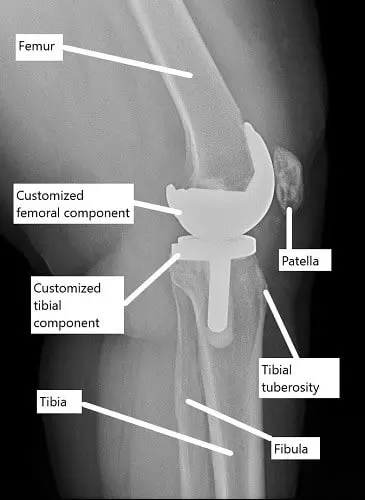
X-ray showing a custom knee replacement.
Customized implants are 3D printed along with customized cutting blocks. The customized implants are made specific to the patient’s natural anatomy of the knee. Unlike generic off-the-shelf implants, these are tailored according to the patient’s biomechanics.
A preoperative CT scan of the patient’s knee and both lower extremities is obtained. A 3D model of the knee anatomy is created with the help of computer software. An assessment of the biomechanical axis of the lower limbs is also made.
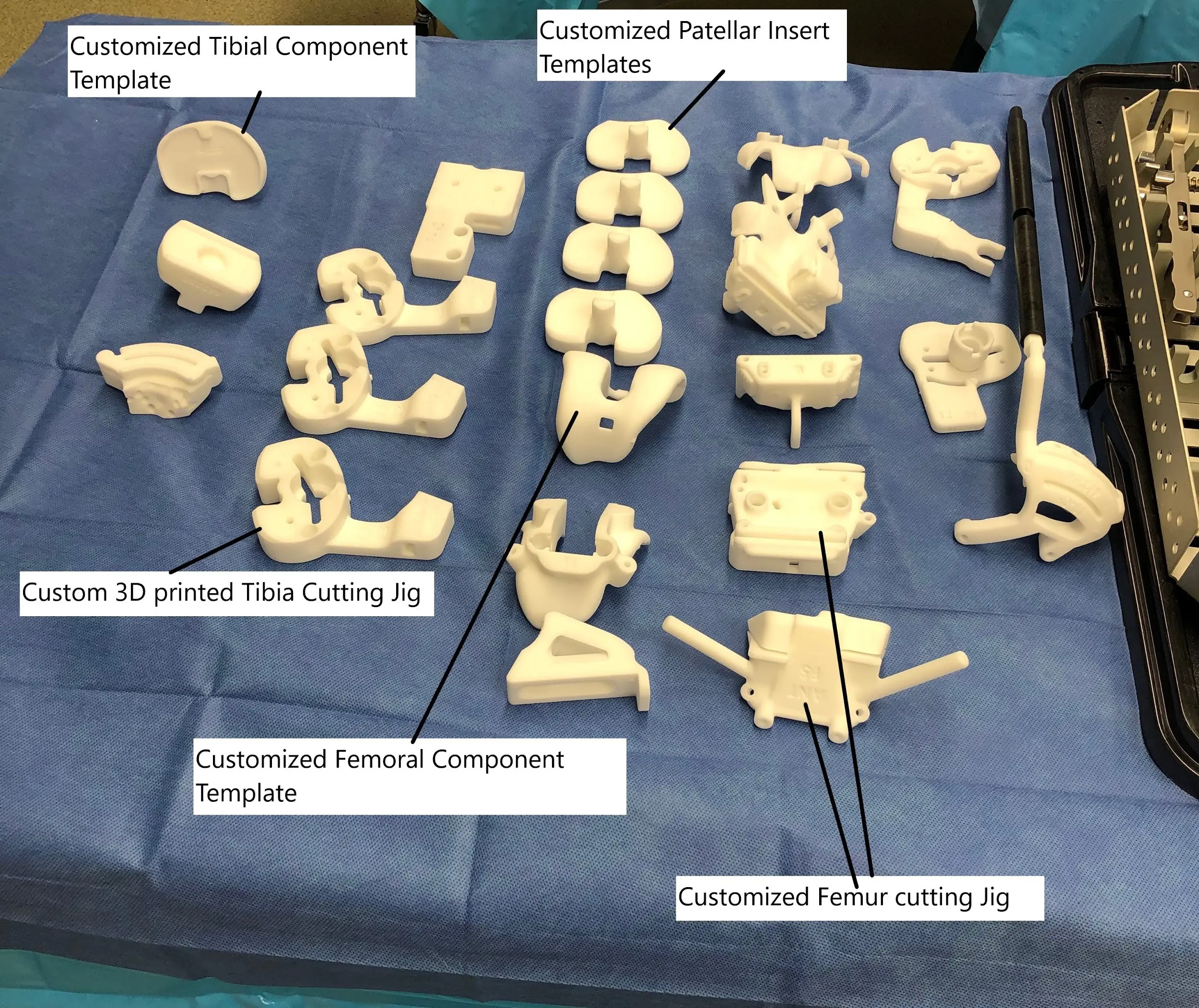
Custom 3D printed cutting blocks.
The data is then used to create patient-specific cutting blocks to minimize bone loss and ensure accurate placement of the customized implants. The result is a more kinematic knee and patients may experience a more natural-feeling knee joint.
Another system utilizes customized instruments/cutting blocks without custom-made implants. The patient’s knee CT/MRI images are used to create 3D anatomy and assess the mechanics of the patient’s knees. The resulting cutting blocks are used to make accurate bone cuts and minimize bone loss. The implants used are off-the-shelf implants.
Although the customized cutting-blocks only system does not use customized implants it offers several benefits. The operating surgeons’ choice while fixing the implant is vastly reduced to only one or a few custom sizes.
The operating surgeon may face difficulties during the surgery while balancing the ligaments and structures around the knee. Some of the patients may have contractures of the knee joint where the knee may have a limited motion before the surgery. The surgeon utilizes specific cutting and loosening of the tissue to obtain full movements around the joint.
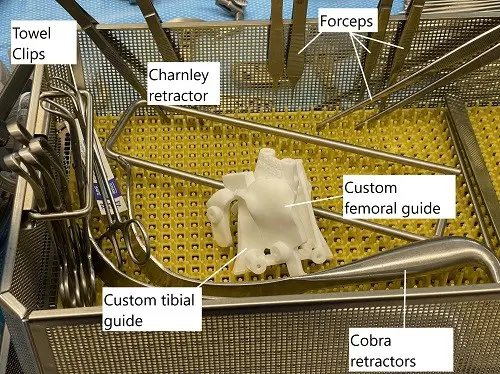
Intraoperative image showing custom cutting blocks.
The above intra-operative challenges may warrant additional bone cuts and may require additional sizes of the implants to fit the changed anatomy. Off-the-shelf implants come in various sizes that may fit the customized bone cuts.
Both customized cutting blocks and customized implants are aimed towards increasing the efficiency of the surgery and achieving better kinematic results of the surgery. While customized cutting blocks help in accurate cutting of the bone, the customized implants are designed according to the patient’s knee anatomy. Speak with your orthopedic surgeon what type of customized knee surgery is best suited in your case.
Traditional Knee Replacement
In a traditional knee replacement, surgeons use standardized implants that come in a range of sizes. During the surgery, the surgeon shapes the patient’s bone to fit the selected implant. This method has been successful for many years, but it has some limitations. Standard implants may not fit every patient perfectly, leading to potential issues such as discomfort, limited range of motion, and a less natural feeling in the knee.
Customized Knee Implants
Customized knee implants are designed to match the unique anatomy of each patient. This approach involves taking detailed images of the patient’s knee using MRI or CT scans. These images are used to create a 3D model of the knee, which guides the manufacturing of an implant that fits the patient’s bone precisely.
Benefits of Customized Knee Implants:
Better Fit: Customized implants match the patient’s anatomy more closely than standard implants, potentially improving comfort and function.
Natural Movement: A better fit can lead to a more natural feeling in the knee, with smoother and more natural movement.
Reduced Surgery Time: The precise fit may reduce the time needed for bone preparation during surgery.
Faster Recovery: Some studies suggest that patients with customized implants may experience faster recovery times due to the more accurate fit and less invasive bone cutting.
Customized Cutting Blocks
Customized cutting blocks, also known as patient-specific instrumentation (PSI), involve creating surgical guides tailored to the patient’s knee anatomy. Like customized implants, this process begins with detailed imaging of the knee. The 3D model generated from these images is used to design cutting blocks that guide the surgeon in making precise bone cuts. The actual implants used can still be standard sizes, but the bone preparation is more tailored to the patient’s anatomy.
Benefits of Customized Cutting Blocks:
Precision: Customized cutting blocks improve the accuracy of bone cuts, leading to a better fit of the standard implants.
Reduced Surgical Errors: The use of patient-specific guides helps reduce the risk of surgical errors.
Efficiency: These blocks can make the surgery more efficient by simplifying the bone-cutting process.
Cost-Effective: Customized cutting blocks can be a cost-effective alternative to fully customized implants while still offering many of the same benefits.
Comparing the Two Approaches
Accuracy and Fit:
- Customized implants offer the highest level of personalization, as both the implant and the surgical guides are tailored to the patient’s anatomy. This can result in a more accurate fit and natural movement.
- Customized cutting blocks provide improved precision in bone cutting compared to traditional methods but use standard implants. This approach still offers a better fit than traditional knee replacements but may not be as precise as fully customized implants.
Surgical Procedure:
- Both methods start with detailed imaging and 3D modeling, but customized implants involve manufacturing a unique implant for each patient. This can add time to the pre-surgical process.
- Customized cutting blocks simplify the surgical procedure by providing precise guides for bone cuts, potentially reducing surgery time and complexity.
Recovery and Outcomes:
- Studies suggest that patients with customized implants may experience quicker recovery times and better long-term outcomes due to the improved fit and function of the implant.
- Patients using customized cutting blocks also benefit from improved surgical precision, which can lead to better outcomes and faster recovery compared to traditional knee replacement
Conclusion
Advancements in knee replacement technology have made it possible to tailor the procedure to individual patients through customized implants and cutting blocks. Both approaches offer significant improvements over traditional knee replacement methods by enhancing the accuracy of the surgery and the fit of the implants. Customized implants provide the highest level of personalization and potential benefits, while customized cutting blocks offer a cost-effective and efficient alternative. Patients should work closely with their surgeons to determine the best option based on their specific needs, anatomy, and recovery goals.
¿Tienes más preguntas?
What is the main difference between customized implants and customized cutting blocks?
Customized implants are uniquely manufactured to match the patient’s knee anatomy, while customized cutting blocks are guides tailored to the patient’s anatomy to improve the precision of bone cuts during surgery. The implants used with cutting blocks are still standard sizes.
Are customized cutting blocks more cost-effective than customized implants?
Yes, customized cutting blocks are generally more cost-effective because they use standard implants but still improve surgical precision through tailored cutting guides.
What imaging techniques are used to create the 3D model for customized implants and cutting blocks?
MRI (Magnetic Resonance Imaging) or CT (Computed Tomography) scans are used to create detailed 3D models of the patient’s knee.
Do customized knee implants reduce surgery time?
Yes, the precise fit of customized implants can reduce the time needed for bone preparation during surgery.
What is the recovery time for patients with customized knee implants?
Patients with customized knee implants may experience faster recovery times compared to those with traditional implants due to the improved fit and less invasive bone cutting.
How do customized cutting blocks improve surgical precision?
Customized cutting blocks are designed based on the patient’s knee anatomy, guiding the surgeon in making precise bone cuts, which improves the fit and alignment of the implants.
Are there any risks associated with customized implants or cutting blocks?
As with any surgical procedure, there are risks, including infection, blood clots, and implant failure. However, the personalized fit can potentially reduce some complications associated with poorly fitting implants.
How do surgeons decide between customized implants and cutting blocks?
Surgeons consider factors such as the patient’s knee anatomy, overall health, cost considerations, and specific recovery goals when deciding between customized implants and cutting blocks.
Can anyone get customized knee implants?
Most patients are candidates for customized knee implants, but suitability depends on individual health conditions, anatomy, and the surgeon’s evaluation.
What are patient-specific instrumentation (PSI) in knee replacement?
PSI refers to customized cutting blocks that are designed based on the patient’s knee anatomy to guide precise bone cuts during surgery.
How long does it take to manufacture a customized knee implant?
It typically takes several weeks to manufacture a customized knee implant, including the time needed for imaging, designing, and production.
Are customized knee replacements covered by insurance?
Coverage varies by insurance provider and plan. Patients should check with their insurance company to understand the coverage for customized knee replacements.
How does the recovery experience differ between customized implants and traditional implants?
Patients with customized implants often report a more natural knee feel, potentially quicker recovery, and improved knee function compared to those with traditional implants.
What are the long-term outcomes for patients with customized knee implants?
Studies suggest that customized knee implants can lead to better long-term outcomes, including improved knee function, higher patient satisfaction, and potentially longer implant lifespan.
Do customized cutting blocks reduce the risk of implant misalignment?
Yes, customized cutting blocks improve the accuracy of bone cuts, reducing the risk of implant misalignment and improving overall surgical outcomes.
What is the typical lifespan of a customized knee implant?
Customized knee implants can last 15-20 years or longer, depending on factors like the patient’s activity level, weight, and overall health.
How do patients prepare for surgery with customized implants or cutting blocks?
Preparation includes pre-surgical imaging, physical examinations, discussions with the surgeon about the procedure, and following preoperative instructions such as fasting and medication adjustments.
What post-operative care is required after knee replacement surgery?
Post-operative care includes physical therapy, pain management, wound care, and follow-up appointments to monitor recovery and implant performance.
How do customized implants improve the natural feel of the knee?
Customized implants match the patient’s unique knee anatomy, leading to a more natural movement and feel compared to standard implants.
Are there any specific activities to avoid after getting a customized knee implant?
Patients should avoid high-impact activities such as running or jumping, but low-impact activities like walking, swimming, and cycling are usually encouraged.
How does a surgeon’s experience with customized implants or cutting blocks impact the surgery’s success?
A surgeon’s experience and skill with customized implants or cutting blocks are crucial for achieving the best outcomes. Patients should choose a surgeon with expertise in these techniques.
What advancements are being made in the field of patient-specific knee replacements?
Advancements include improved imaging techniques, more sophisticated 3D modeling software, and new materials for implants that enhance durability and compatibility with the human body.