
Subchondroplasty is a minimally invasive procedure used to treat knee pain caused by bone marrow lesions, also called bone marrow edema. These lesions occur in the bone just beneath the cartilage and can lead to swelling, stress reactions, or stress-type fractures. When these painful areas do not heal with rest or medicine, subchondroplasty can help relieve pain and support the bone, sometimes delaying or preventing the need for knee replacement.
How Common It Is and Who Gets It? (Epidemiology)
Subchondroplasty is most often used in adults who have knee pain linked to bone marrow lesions seen on magnetic resonance imaging. Many patients also have early or moderate arthritis. It is less common than standard surgical treatments but is becoming more widely used as more people are diagnosed with bone marrow lesions on advanced imaging.
Why It Happens – Causes (Etiology and Pathophysiology)
Bone marrow lesions form when stress builds up in the bone under the cartilage. This may happen after twisting injuries, overuse, falls, or because of arthritis. The pressure inside the bone increases, leading to swelling and pain. When the pressure persists, the area may fail to heal, creating a stress-type fracture. This can make knee pain worse and speed up joint damage.
How the Body Part Normally Works? (Relevant Anatomy)
Healthy bone under the cartilage helps absorb force as the knee moves. When a bone marrow lesion forms, the underlying bone becomes swollen and weak. This affects the cartilage above it and can lead to worsening arthritis. Subchondroplasty targets this weakened area by drilling a small channel to relieve pressure and filling it with a supportive material.
What You Might Feel – Symptoms (Clinical Presentation)
People with bone marrow lesions often have deep knee pain, especially when standing or walking. They may feel tenderness along the joint line and may or may not recall an injury. Swelling, stiffness, and pain with activity are common. Pain does not always improve with rest or medicines.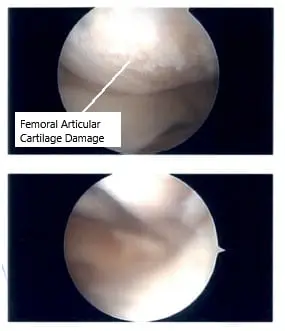
Arthroscopic image showing articular cartilage damage.
How Doctors Find the Problem? (Diagnosis and Imaging)
Diagnosis begins with an exam and review of symptoms. X-rays may show arthritis, while magnetic resonance imaging is needed to detect bone marrow lesions. These lesions appear as cloudy white areas on certain imaging sequences and show where stress and swelling are occurring inside the bone.
Classification
Bone marrow lesions may be classified by size, location, and severity. They may appear near the inner knee, outer knee, or under the kneecap. The presence of these lesions in patients with arthritis may predict faster joint damage and a higher chance of needing knee replacement within several years.
Other Problems That Can Feel Similar (Differential Diagnosis)
Other causes of knee pain include cartilage tears, meniscus tears, ligament strains, tendon irritation, and bursitis. These conditions can also produce joint line tenderness and swelling. Magnetic resonance imaging helps distinguish bone marrow lesions from these other problems.
Treatment Options
Non-Surgical Care
Before surgery, patients are treated with anti-inflammatory medicine, ice, rest, elevation, and compression. Many also try physical therapy. If symptoms do not improve, further imaging is used.
Surgical Care
Subchondroplasty is done in an outpatient setting. The surgeon often performs knee arthroscopy at the same time to look inside the joint and treat other issues such as cartilage or meniscus tears. Under X-ray guidance, a small channel is drilled into the lesion to reduce pressure, and a bone paste or cement is injected to support the area. Patients usually go home the same day.
A variation called intraosseous bioplasty uses a wider decompression and fills the area with platelet-rich plasma mixed with demineralized bone matrix.
Procedure
This surgery is done in an outpatient setting. It is usually combined with arthroscopic examination of the knee, which helps to look inside the knee and take care of any pathologies, which may or may not be diagnosed on the MRI which include meniscal tear or cartilage lesions. It also helps in preventing complications of subchondroplasty, that is extravasation of the material into the joint.
Subchondroplasty is done under x-ray imaging control in the operating room. The patients usually will have two to four stitches after the procedure. The patients are sent home the same day within a couple of hours after procedure. They will require the need for assistive device like crutches for ambulation for 3-4 weeks.
They are sent home with pain medications and asked to follow within a week with the surgeon. They are asked to elevate and ice and use pain medications as directed to take care of the pain and swelling in the knee joint. The patients are allowed to ambulate as well as do activities of daily living as tolerated.
They are usually seen in one week and physical therapy for the knee is started at that time. It may take up to 8-10 weeks to heal completely.
IntraOsseous Bioplasty (Arthrex)
Bioplasty is a variation in which a wider decompression is done and the drill hole is filled with biologic material in the form of Platelet rich Plasma (PRP) mixed with Demineralized Bone Matrix (DBM). Both procedures have shown good results in carefully selected patients and help in preventing rapid deterioration of the joint and delay or prevent joint replacement surgery.
Recovery and What to Expect After Treatment
Patients typically leave the same day and may need crutches for three to four weeks. They use ice, elevation, and medicine to manage swelling and pain. A follow-up visit occurs within a week, and physical therapy starts around that time. Full healing may take eight to ten weeks.
Possible Risks or Side Effects (Complications)
Possible complications include leakage of the injected material into the joint, swelling, or pain after the procedure. As with any surgery, there is a risk of infection or reactions to anesthesia. Careful imaging and arthroscopy reduce the risk of material entering the joint.
Long-Term Outlook (Prognosis)
Research suggests that treating bone marrow lesions can improve pain and motion. Subchondroplasty may delay or prevent knee replacement in the right patient, giving time before more advanced surgery is needed.
Frequently Asked Questions (FAQ)
Q. Is subchondroplasty painful?
A. Mild discomfort is expected, but pain is usually managed with medicine, ice, and rest.
Q. Will I need crutches?
A. Yes, most patients use crutches for several weeks.
Q. Does this prevent knee replacement?
A. It may delay or prevent it in some patients, depending on the severity of arthritis.
Q. How soon can I walk?
A. You can walk with support as tolerated, but activity must follow your surgeon’s guidance.
Q. Will the bone paste stay in place?
A. Yes, it hardens inside the bone to support healing.
Summary and Takeaway
Subchondroplasty is a minimally invasive option for patients with painful bone marrow lesions that do not heal with rest or medicine. It helps reduce pressure inside the bone, supports healing, and may delay or prevent knee replacement. The procedure is usually outpatient, combined with arthroscopy, and followed by several weeks of guided recovery.
Clinical Insight & Recent Findings
A recent study followed 79 patients with mild-to-moderate knee osteoarthritis and persistent bone-marrow lesions and found that subchondroplasty produced significant improvements in pain, function, and quality of life within the first year, with KOOS pain scores rising from 45.4 at baseline to 74.8 at 12 months and no serious complications reported .
These findings parallel the clinical points above: treating bone-marrow lesions—often the source of deep, unrelenting knee pain—can meaningfully reduce symptoms, support the stressed subchondral bone, and potentially delay the need for knee replacement in appropriately selected patients.
The study also noted that outcomes were consistent regardless of lesion size, location, or patient demographics, reinforcing why subchondroplasty or intraosseous bioplasty can be valuable minimally invasive options for patients who have not improved with conservative therapy. (“Study of subchondroplasty outcomes – see PubMed.“)
Who Performs This Treatment? (Specialists and Team Involved)
Orthopedic surgeons trained in knee procedures perform subchondroplasty. Nurses, anesthesiologists, therapists, and support staff assist before, during, and after surgery.
When to See a Specialist?
You should see a specialist if knee pain persists despite rest and medicine, or if magnetic resonance imaging shows bone marrow lesions that match your symptoms.
When to Go to the Emergency Room?
Seek emergency care if you develop sudden severe pain, fever, redness, swelling that worsens, or trouble walking after the procedure.
What Recovery Really Looks Like?
Recovery involves limited weight-bearing at first, use of crutches, early physical therapy, and slow improvement in comfort. Swelling and soreness are normal. Most patients feel better in several weeks and continue improving for months.
What Happens If You Ignore It?
Untreated bone marrow lesions can worsen, cause more pain, and speed up joint damage. They are linked to higher chances of needing knee replacement if not managed.
How to Prevent It?
Maintaining a healthy weight, using proper form during activity, and treating early knee injuries can reduce stress on the bone. Early imaging helps detect lesions before they worsen.
Nutrition and Bone or Joint Health
Eating a balanced diet with protein, calcium, and vitamin D supports bone healing. Staying hydrated helps overall joint health.
Activity and Lifestyle Modifications
Patients should avoid high-impact activity until healed. Low-impact exercises like walking or cycling are recommended once therapy begins. Following the recovery plan helps protect the treated area and improve long-term results.
Do you have more questions?
What exactly is subchondroplasty?
Subchondroplasty is a minimally invasive surgical procedure that involves the injection of a bone substitute, typically calcium phosphate, into the subchondral bone where bone marrow lesions (BMLs) are present. This technique aims to stabilize the bone, alleviate pain, and prevent further deterioration of the joint.
Who are the ideal candidates for subchondroplasty?
Ideal candidates for subchondroplasty include patients with persistent knee pain due to osteoarthritis, who exhibit bone marrow lesions on MRI, and have not responded adequately to conservative treatment methods. Patients should not be immediate candidates for total knee replacement.
How is subchondroplasty performed?
The procedure is performed under fluoroscopic guidance to ensure accurate placement of the injection. A mixture of a solid and fluid bone substitute is injected through a cannula into the affected area, filling the lesions and supporting the bone’s natural healing process.
What are the risks associated with subchondroplasty?
As with any surgical procedure, subchondroplasty carries risks such as infection, bleeding, and reaction to anesthesia. Specific to this procedure, there is a risk of the injected material leaking or migrating, and potential for an inflammatory response to the bone substitute.
How long is the recovery period after subchondroplasty?
Recovery varies but typically patients can return to normal activities within a few weeks. Pain and mobility improvement can be noticed as early as a few days post-operation, although full benefits might take several weeks to manifest.
Is subchondroplasty covered by health insurance?
Coverage can vary depending on the patient’s health insurance plan and the specific indications for the procedure. It’s important to consult with the insurance provider prior to the procedure to understand coverage details.
Can subchondroplasty be repeated if symptoms persist?
Yes, the procedure can be repeated, but the necessity for this would depend on the individual patient’s response to the initial treatment and progression of underlying conditions such as osteoarthritis.
What are the success rates of subchondroplasty?
Success rates vary, but studies generally report significant improvements in pain and function. Many patients experience relief from symptoms and improved quality of life following the procedure.
What alternatives are there to subchondroplasty?
Alternatives to subchondroplasty include conservative treatments like physical therapy and medications, as well as more invasive procedures like osteotomy or total knee replacement, depending on the severity of the condition.
What are bone marrow lesions?
Bone marrow lesions are areas within the bone that show up on an MRI as regions of increased fluid. They are often associated with pain and are indicative of changes in the bone that could lead to further joint deterioration.
How does subchondroplasty impact future knee surgeries?
Subchondroplasty does not typically affect the outcomes of future knee surgeries such as total knee replacement. It can serve as a bridge therapy, potentially delaying the need for more invasive surgeries
What type of anesthesia is used during subchondroplasty?
The procedure can be performed under local anesthesia, regional anesthesia, or general anesthesia, depending on the extent of the procedure and the patient’s needs.
How is subchondroplasty different from standard bone grafting?
Unlike traditional bone grafting, subchondroplasty specifically targets subchondral bone lesions using a minimally invasive approach and injects a flowable bone substitute rather than solid graft material.
What symptoms indicate the need for subchondroplasty?
What symptoms indicate the need for subchondroplasty?
Can subchondroplasty be performed on other joints besides the knee?
While it is most commonly performed on the knee, subchondroplasty can also be applied to other joints experiencing similar issues, such as the hip or ankle, though these applications are less common.
What is the long-term efficacy of subchondroply?
The long-term efficacy of subchondroplasty appears promising based on current research. Patients often report sustained improvement in pain and function, with effects lasting for several years. However, the long-term success also depends on the progression of the underlying joint condition, like osteoarthritis.
Does subchondroplasty prevent the need for knee replacement?
While subchondroplasty can delay the need for knee replacement by alleviating symptoms and stabilizing the joint, it does not cure the underlying osteoarthritis. For some patients, knee replacement may still be necessary in the future.
Are there age restrictions for undergoing subchondroplasty?
There are no strict age restrictions, but the procedure is typically recommended for middle-aged and older adults who suffer from bone marrow lesions due to osteoarthritis or other degenerative joint diseases.
What postoperative care is required after subchondroplasty?
Postoperative care typically involves pain management, gradual weight-bearing activities, and physical therapy to restore mobility and strengthen the joint.
How quickly can I return to normal activities after subchondroplasty?
Most patients are able to resume light activities within a few days and return to more normal levels of activity within several weeks, depending on the individual’s health status and the specifics of their procedure.
What are the signs of complications after subchondroplasty?
Signs of potential complications include excessive pain, swelling, redness, or drainage at the injection site, and fever. Any of these symptoms should prompt immediate consultation with a healthcare provider.
How does the injected bone substitute integrate with my own bone?
The calcium phosphate bone substitute gradually integrates with the surrounding bone tissue through a process called osteointegration, helping to restore the strength and structure of the subchondral bone.
Can subchondroplasty be done alongside other knee surgeries?
Yes, subchondroplasty can be performed in conjunction with other procedures such as arthroscopy to address additional joint issues like cartilage damage.
What is the success rate of subchondroplasty in younger patients?
While there is limited data specifically on younger patients, those without advanced degenerative changes tend to respond well to subchondroplasty, with good improvement in pain and function.
Is there a preferred season or time of year to undergo subchondroplasty?
There is no preferred season for undergoing subchondroplasty. The decision should be based on the patient’s clinical needs, lifestyle, and the advice of their orthopedic surgeon.