
The New York State workers compensation board has developed these guidelines to help physicians, podiatrists, and other healthcare professionals provide appropriate treatment for Therapeutic Procedures.
These Workers Compensation Board guidelines are intended to assist healthcare professionals in making decisions regarding the appropriate level of care for their patients with ankle and foot disorders.
The guidelines are not a substitute for clinical judgement or professional experience. The ultimate decision regarding care must be made by the patient in consultation with his or her healthcare provider.
Therapeutic Procedures: Operative
Every surgical intervention must be supported by a strong relationship between clinical findings, clinical trajectory, and diagnostic tests. A thorough integration of these criteria must result in a precise diagnosis with a confirmatory finding of the pathologic condition (s).
Prior to considering elective surgical intervention, it is crucial to rule out non-physiologic modifiers of pain presentation as well as non-operative conditions that mimic radiculopathy or instability (e.g., peripheral neuropathy, piriformis syndrome, myofascial pain, scleratogenous or sympathetically mediated pain syndromes, sacroiliac dysfunction, psychological conditions, etc.).
Additionally, operative treatment is advised when the natural course of surgically treated lesions is superior to that of untreated lesions. In order to identify mechanical pain generators that may be responsive to non-surgical treatments or may be refractory to surgical intervention, all patients who are being considered for surgical intervention should first have a thorough neuromusculoskeletal assessment.
Knee Fusion of Therapeutic Procedures: Operative
Description / Definition: Femur to tibia surgical fusion at the knee joint.
Diagnostic Testing Procedures
Gallium scan (R/O infection), MRI, and radiographs. Work in the lab as directed.
- Non-Operative Therapy for weight-sharing braces NSAIDsNon-Operative Therapy for weight-sharing braces NSAIDs are recommended in a small number of patients when clinically indicated.
- Operative TreatmentOperative Treatment is recommended in a small number of patients when clinically indicated.Grafting, internal fixation, and typically open reduction. You could also use intramedullary rodding or external fixation.Indications: Other reasonable surgical treatments have been actively studied or put into practise after all reasonable conservative procedures have been exhausted.
- Post-Operative Therapy Rest/restricted activity, off-loading with crutches or cane, NSAIDs, APAP, that is to be followed by active therapy for protected weight-bearing and gait trainingPost-Operative Therapy Rest/restricted activity, off-loading with crutches or cane, NSAIDs, APAP, that is to be followed by active therapy for protected weight-bearing and gait training are recommended in select patients as clinically indicated.Following active therapy for protected weight-bearing and gait training, rest/restricted activity, off-loading with crutches or a cane, NSAIDs, and APAP are recommended.
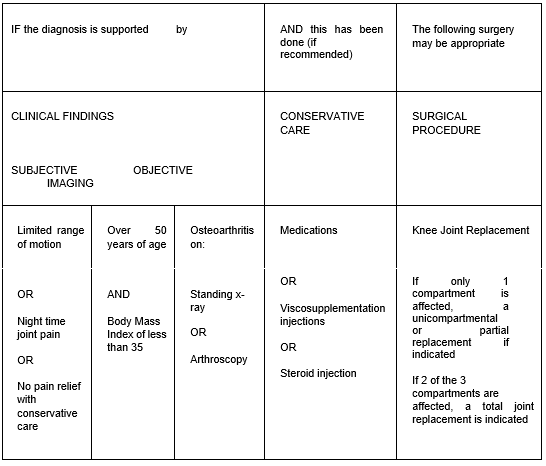
- Knee Arthroplasty of Therapeutic Procedures: OperativeThe list of pre-authorized operations does not include knee arthroplasty (total or partial knee joint replacement). Providers who wish to carry out one of these operations must first submit a pre-authorization request to the carrier.
Table 8: Criteria for Knee Arthroplasty
Amputation of Therapeutic Procedures: Operative
- Description / DefinitionSurgical removal of a portion of the lower extremity.
- Mechanism of InjuryUsually secondary to post-traumatic bone, soft tissue, vascular or neurologic compromise of part of the extremity.
- Specific Physical FindingsNon-useful or non-viable portion of the lower extremity.
- Diagnostic Testing Procedures radiographs, vascular studiesDiagnostic Testing Procedures radiographs, vascular studies are recommended as clinically indicated.
- Non-Operative TreatmentNon-Operative Treatment is not recommended
- Operative Treatment AmputationOperative Treatment Amputation is recommended in select patients as clinically indicated.Indications: the extremity’s non-viable or ineffective portion
- Post-Operative Therapy of Therapeutic Procedures: OperativeRest and limited exercise, cane or crutch off-loading, NSAIDs, and APAP are to be followed by active and/or passive therapy for prosthetic fitting, construction, and training, as well as protected weight-bearing.
- Post-Operative Therapy of Therapeutic ProceduresPost-Operative Therapy of Therapeutic Procedures: Operative is Recommended – in select patients as clinically Indicated.
Manipulation Under Anesthesia (MUA) of Therapeutic Procedures: Operative
- Description / DefinitionJoint’s passive range of motion while sedated.
- Mechanism of InjuryJoint stiffness that typically follows a catastrophic injury, surgery related to compensating, or other therapy.
- Specific Physical FindingsRigidity of the joints in active and passive modes.
- Diagnostic ProceduresRadiographs
- Non-Operative Treatment Therapy for active and passive range of motion exercisesNon-Operative Treatment Therapy for active and passive range of motion exercises is recommended in select patients as clinically indicated.
- Surgical IndicationsIs recommended in instances of irreversible limitation and a properly trained surgeon may carry out the operation. Think about if standard therapy techniques, incorporating dynamic and/or physical therapy Using bracing, avoid restoring the range of motion that should be anticipated following a reasonable amount of normally lasting at least 12 weeks.
- Operative TreatmentOperative Treatment is not recommended.
- Post-Operative Therapy for active and passive range of motionPost-Operative Therapy is recommended in select patients as clinically indicated.
Bursectomy of Therapeutic Procedures: Operative
- Description / DefinitionSurgical removal of peri-articular bursa.
- Mechanism of InjuryTypically, a localized acute injury or chronic mild irritation occurs.
- Specific Physical FindingsBursa-related swelling and discomfort
- Diagnostic Testing Procedures of RadiographsDiagnostic Testing Procedures of Radiographs are recommended as clinically indicated.
- Non-Operative TreatmentNon-Operative Treatment is recommended in select patients as clinically indicated.
- Surgical IndicationsDespite treatment, there is ongoing discomfort and edema.
- Operative TreatmentSurgical removal of the bursa.
- Post-Operative TherapyRest/restricted activity, off-loading with crutches or a cane, APAP, NSAIDs, and graduated range of motion exercises may come next, along with active and/or passive rehabilitation.It is advised in certain patients when clinically indicated.
Osteotomy of Therapeutic Procedures: Operative
- Description / DefinitionAre constructive technique that involves cutting the bone during surgery in order to realign it; it is beneficial for patients who might benefit from realignment instead of total joint replacement.
- Mechanism of InjuryDeformity or arthritis following trauma.
- Specific Physical FindingsDeformity or painfully reduced range of motion.
- Diagnostic Testing Procedures radiographs, MRI, CT scanDiagnostic Testing Procedures radiographs, MRI, CT scan are recommended clinically appropriate in a subset of patients.
- Non-Operative TreatmentNon-Operative Treatment is recommended clinically appropriate in a subset of patients.
- Operative TreatmentOperative Treatment is recommended clinically appropriate in a subset of patients.Nonsurgical treatment’s failure. Total joint arthroplasty should be avoided.
- Post-Operative TherapyPost-Operative Therapy is recommended clinically appropriate in a subset of patients.
Hardware Removal of Therapeutic Procedures: Operative
- Description / DefinitionSurgical removal of internal or external fixation devices.
- Mechanism of InjuryUsually after the healing of a post-traumatic injury that requires instrumentation for fixing or reconstruction.
- Specific Physical FindingsLocal pain to palpation, swelling, erythema.Diagnostic Testing Procedures Radiographs, tomography, CT scan, MRI
- Non-Operative TreatmentNon-Operative Treatment is recommended in select patients as clinically indicated.
- Operative TreatmentOperative Treatment is recommended clinically appropriate in a subset of patients.
- Post-Operative TherapyPost-Operative Therapy is recommended clinically appropriate in a subset of patients.
Release of Contracture of Therapeutic Procedures: Operative
- Description / DefinitionLengthening of periarticular soft tissue or lengthening of a constricted tendon through surgery.
- Mechanism of InjuryUsually following a post-traumatic injury.
- Specific Physical FindingsShortened tendon or stiff joint.Diagnostic Testing Procedures Radiographs, CT scan, MRI scan.
- Non-Operative Treatment Therapy for stretching range of motion exercisesNon-Operative Treatment Therapy for stretching range of motion exercises are recommended in select patients as clinically indicated.
- Operative TreatmentOperative Treatment is recommended in select patients as clinically indicated.
- Post-Operative TherapyPost-Operative Therapy is recommended – in select patients as clinically indicated.
Meniscectomy of Therapeutic Procedures:
- Operative Description / DefinitionThe surgical excision of a meniscus
- Meniscectomy of Therapeutic Procedures: OperativeDescription / DefinitionThe surgical excision of a meniscus
- Ligament Repair of Therapeutic Procedures: OperativeDescription / Definition The surgical reattachment of torn anterior or posterior cruciate ligaments or medial or lateral collateral ligaments.
What our office can do if you have workers compensation injuries
We have the experience to help you with their workers compensation injuries. We understand what you are going through and will meet your medical needs and follow the guidelines set by the New York State Workers Compensation Board.
We understand the importance of your workers compensation cases. Let us help you navigate through the maze of dealing with the workers compensation insurance company and your employer.
We understand that this is a stressful time for you and your family. If you would like to schedule an appointment, please contact us so we will do everything we can to make it as easy on you as possible.